From research to industrial reality
Artificial intelligence is developing at an enormous pace. Yet whilst technological breakthroughs constantly open up new possibilities, their practical implementation in industrial production processes often presents companies with considerable challenges. Hub4000 is dedicated precisely to this interface. Founded in July, the innovation platform sees itself as a link between science and industry and aims to translate new technologies into marketable applications more quickly.
“However, there is often a long way to go between scientific discovery and successful industrial application,” explains Hub4000 Managing Director Dr Martin Bergsmann.
The AI Sandbox now provides a flexible research and testing environment for this purpose. Companies can work alongside scientific institutions to develop innovative AI solutions, test their practical viability and gain valuable experience for subsequent industrial deployment.
The concept deliberately emphasises openness and adaptability: rather than permanently installed test set-ups, the premises are configured on a project-by-project basis and made available for new projects once the respective research work has been completed.
When humanoid robots take on industrial tasks
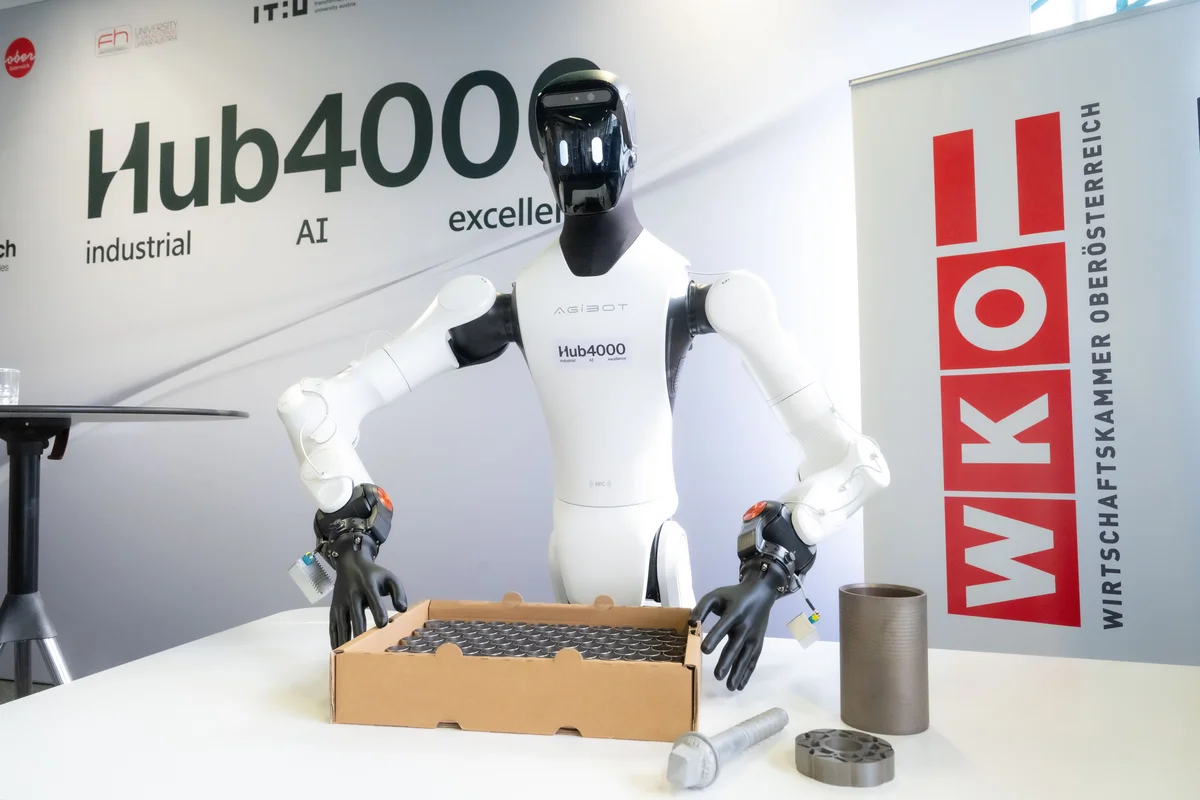
The first project, HUM-MATIQ, which was launched back in September, demonstrates exactly how this interplay between research and industrial application can work in practice. Nine companies, in collaboration with the University of Applied Sciences Upper Austria, Johannes Kepler University Linz and the Software Competence Centre Hagenberg, are investigating the potential that humanoid robots offer for industrial production processes.
The focus is on the Agibot G2 humanoid robot. It is designed to learn to handle components weighing up to ten kilograms, check their quality using optical methods and decide on their further use based on AI-supported analyses.
“The companies are contributing various real-world objects from their production processes for handling and quality control. The project partners can test their applications in the laboratory setup,” explains Bergsmann.
This is not just about the technical capabilities of individual robots, but above all about determining the conditions under which such systems can be integrated into existing production processes in a meaningful, reliable and cost-effective manner.
Humans as the machine’s teachers
Another research project is dedicated to a particularly exciting prospect: direct collaboration between humans and humanoid robots. Together with the Creative Robotics Lab at the University of Art and Design Linz, six industrial companies are investigating how robots can be deployed for new tasks in future without the need for complex programming.
At the heart of this is the idea of teaching machines through natural language and practical demonstrations. Employees could show robots work processes directly and thus pass on their practical knowledge straight to intelligent systems.
“The focus here is not on the robot, but on the skilled worker with their practical experience,” emphasises Bergsmann. Alongside the technological possibilities, organisational issues are also being examined: How is collaboration between humans and machines changing? What new requirements are emerging for work processes and skills? And how can intelligent assistance systems actually ease the workload for employees in day-to-day production?
An innovation network with a long-term perspective
Behind Hub4000 lies a broad network spanning science and research. The founding members and supporting organisations include the Upper Austrian Chamber of Commerce, Upper Austrian Research GmbH, Johannes Kepler University Linz, the Interdisciplinary Transformation University (IT) and the University of Applied Sciences Upper Austria.
Their shared aim is to drive forward the development and application of industrial artificial intelligence in Upper Austria in a sustainable manner. The AI Sandbox is intended to be more than just a traditional research laboratory: it sees itself as an open innovation space where businesses and academia can experiment together, explore technological boundaries and unlock new applications.
#absolutelybrilliant when today’s experiments soon become an integral part of tomorrow’s industrial working world.