The country’s first large-scale battery storage facility was delivered to Siegendorf at the end of 2025 and is designed to temporarily store surplus electricity generated from wind and solar power. This means that energy can be used exactly when it is needed, even when there is no wind or the sun is not shining.
Storing electricity instead of wasting it
The fundamental problem with renewable energy is well known: wind and sun do not provide a constant supply of electricity, but one that depends on the weather. On particularly sunny or windy days, more energy is often generated than can be consumed immediately. Without storage, some of this surplus is lost.
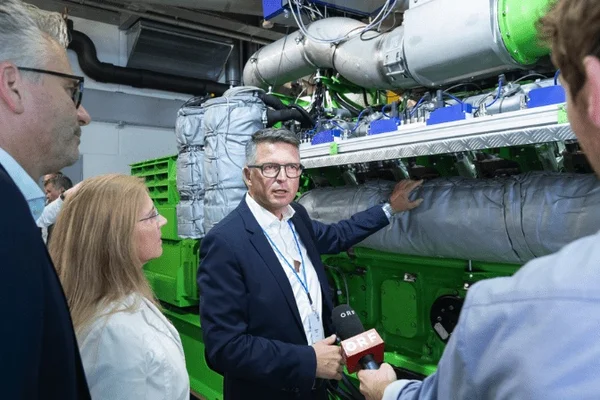
The new large-scale lithium-ion storage facility in Siegendorf is designed to prevent exactly that. The plant has a capacity of two megawatts and a storage volume of five megawatt-hours. According to Burgenland Energie, this is roughly equivalent to the capacity of around 100 electric cars.
An important step towards energy independence
For Burgenland Energie, the storage facility is part of a wider strategy. A total of eight large-scale battery storage projects are planned in Burgenland. The aim is to make the province energy-independent by 2030 and to further increase security of supply. The stored energy is fed into the grid via the Siegendorf substation. The planned operational life of the facility is around 15 years.
The project could also prove significant from an economic perspective: storage facilities help to stabilise electricity prices and relieve pressure on the grid. This technology is becoming increasingly important, particularly in times of highly fluctuating energy prices.
Burgenland as an energy model
Burgenland is already regarded as a pioneer in wind power and photovoltaics. The expansion of electricity storage facilities is now intended to take the energy transition to the next level. After all, renewable energy alone is not enough. It must also be reliably available.
That is precisely why the project in Siegendorf is more than just a technical project. It is a symbol of how regional energy supply could work in the future: sustainably, independently and stably.
#schongenial when electricity is not only generated but also stored on a large scale, ensuring it remains available at all times.