From ancient recycling to the modern circular economy
The history of glass stretches back several millennia. The first glass-like materials were produced as early as in ancient Mesopotamia and Egypt. The Romans recognised the advantages of the material at an early stage and systematically recycled glass. Old glass shards were collected, crushed and remelted – not so much for environmental reasons, but because the production of virgin glass was extremely energy-intensive.
Today, glass recycling has taken on a whole new significance. In the face of rising energy prices, scarce resources and ambitious climate targets, every tonne of recycled glass counts. The use of cullet significantly reduces the need for primary raw materials such as quartz sand, lime and soda. At the same time, energy consumption in glass production falls significantly: using just 10 per cent cullet saves around 3 per cent in energy and reduces CO₂ emissions by approximately 3.6 per cent. Modern container glass production facilities now operate with cullet content of up to 70 per cent.
However, the higher the demands on glass products become, the more important the quality of the recycled material becomes. Foreign materials such as ceramics, porcelain, metals or heat-resistant glass can cause production disruptions even in the smallest quantities.
Binder+Co: Technology leader in waste glass processing
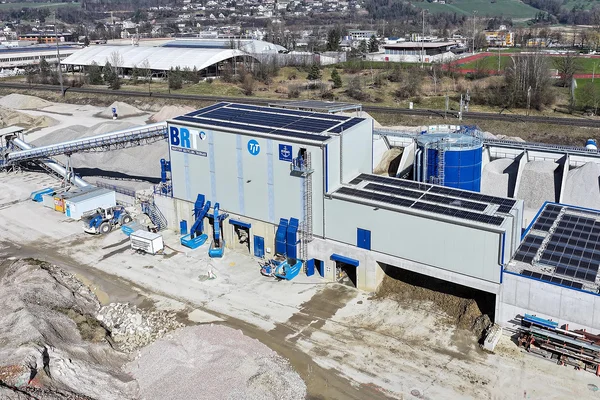
Modern waste glass processing is far more than simply sorting bottles. It consists of a multitude of high-precision process steps that must be perfectly coordinated. Binder+Co develops complete plant solutions for this purpose: from mechanical pre-processing to sensor-based high-performance sorting.
The company relies on specially developed technologies right from the crushing stage. The crushing and screening drum enables particularly gentle pre-crushing of the glass, whilst at the same time coarse foreign materials are removed. Subsequently, various screening machines separate the material into different particle sizes. Among other things, BIVITEC screens, long-particle separators and air classifiers are used to efficiently remove plastics, cardboard or organic matter.
However, sensor-based sorting is particularly crucial. With the CLARITY system from Binder+Co, every single piece of glass is analysed within milliseconds. High-resolution sensors and cameras detect miscoloured glass, ceramics, stones, porcelain, plastics or heat-resistant glass and use compressed air jets to remove these specifically from the material stream. Various sensor technologies – including UV, infrared and transmitted light methods – ensure the highest levels of purity.
High-tech for maximum purity and efficiency
The glass industry’s rising quality demands continue to drive technological development. Today, modern recycling plants must not only process large volumes but also ensure the highest levels of purity. That is why Binder+Co is increasingly integrating data-driven processes, automated quality controls and intelligent analysis tools.
One example of this is the CLARITY QC system. It continuously monitors product quality during operation and detects deviations immediately. This allows processes to be optimised, downtime to be avoided and consistent end-product quality to be ensured. At the same time, digital monitoring systems and predictive maintenance concepts enable higher plant availability and more efficient maintenance planning.
Energy-efficient process steps also play a central role. The DRYON fluidised-bed dryer from Binder + Co reduces the moisture content of the material whilst consuming little energy, whilst simultaneously improving the sortability of the cullet. The aim is always to achieve a recycling process that is as resource-efficient and loss-free as possible.
Circular economy as a global model for the future
International projects by Binder+Co demonstrate that modern recycling technology is in demand worldwide. In collaboration with the Brazilian company MASSFIX, plants have been developed that process hundreds of thousands of tonnes of packaging and flat glass annually. Innovative zero-waste concepts are also emerging in Austria, where metals, ceramics and mineral materials are recovered in addition to glass.
Glass recycling is thus increasingly evolving from a traditional waste management task into a highly dynamic technological sector. #schongeniale companies such as Binder+Co demonstrate that a modern circular economy is only possible with intelligent processes, high-precision sorting technology and consistent innovation.