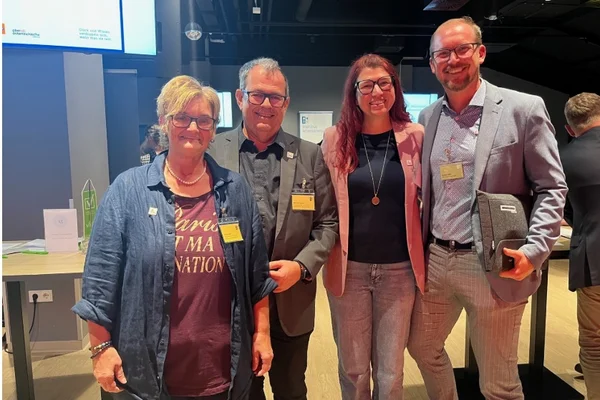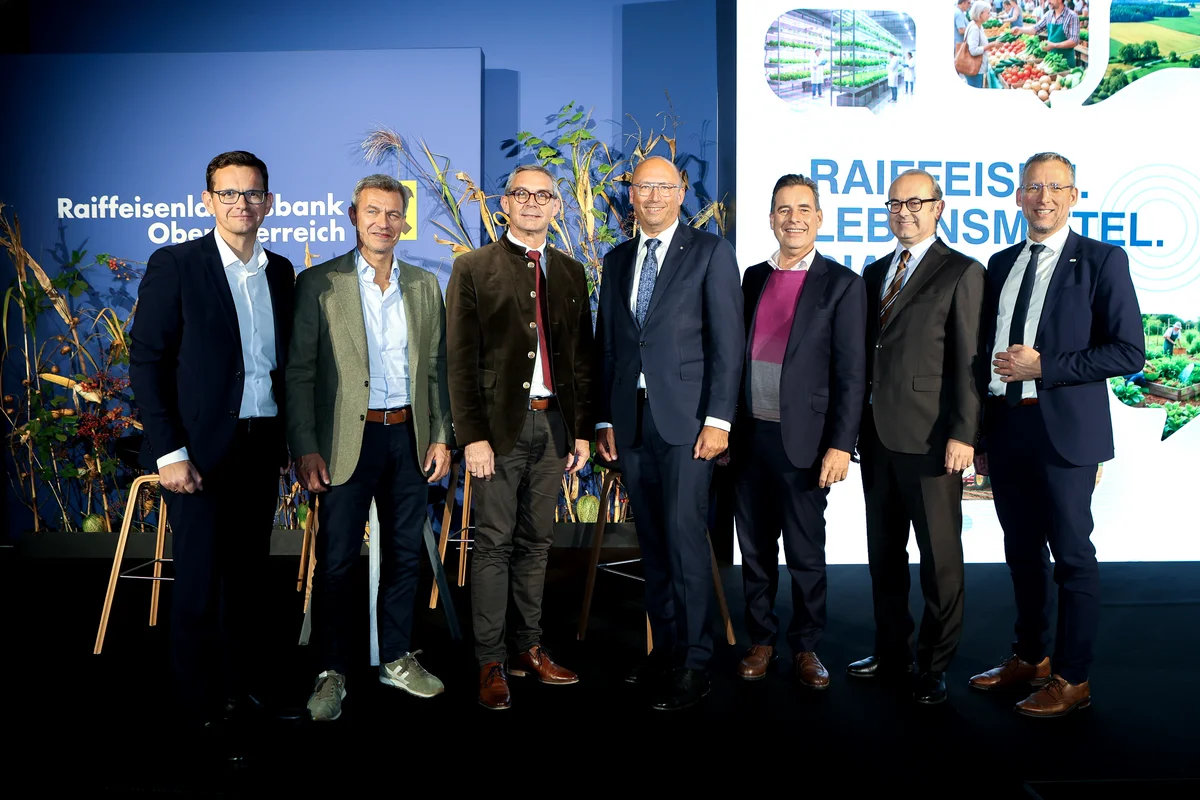
Around 120 guests recently accepted an invitation from Raiffeisenlandesbank Oberösterreich to attend the RaiffeisenForum in Linz. The focus was on how high-quality food can continue to be successfully produced and processed in Upper Austria in the future.
Securing the future together
RLB OÖ Chief Executive Reinhard Schwendtbauer emphasised how closely Raiffeisen is linked to agriculture: “We were founded 137 years ago by the agricultural sector and remain firmly committed to our agricultural roots; after all, 85 per cent of farmers in Upper Austria work with us. We want to help ensure that production, processing and investment continue in Upper Austria in the future.”
Franz Waldenberger, President of the Chamber of Agriculture, highlighted that this goal is becoming increasingly challenging in the face of rising costs, changing markets and climate-related challenges. This makes reliable framework conditions and close cooperation throughout the entire value chain all the more important. After all, what begins in local fields continues through processing and ultimately ends up on supermarket shelves.
Regionality needs visibility
To ensure that regional products can be purchased as a conscious choice, their origin must be clearly recognisable to consumers. Thomas Krahofer, Managing Director of the efko Group, summed it up: “If consumers are to make a conscious choice in favour of regional products, they must also be able to recognise the origin of a food product. Mandatory origin labelling could create greater transparency in this regard.”
In addition to this transparency, changing dietary habits are also opening up new prospects. Matthias Krön, Managing Director of The New Originals Company, highlighted the growing importance of plant-based foods. Upper Austria already plays a key role in soya cultivation. In future, locally grown beans could also find their way onto our plates more often.
Innovation for the future
To capitalise on such opportunities, a long-term perspective is needed. Johannes Schuster, Director-General of Raiffeisen Ware Austria AG, emphasised the importance of planning certainty, as agricultural investments often have an impact across generations. Norbert Marcher, Managing Director of the Marcher Group, also sees great potential for domestic meat production.
Klaus Schörghofer, CEO of VIVATIS Holding AG, outlined how this potential can be exploited even more effectively in future. Digitalisation, automation and innovation can make a decisive contribution to keeping Austria competitive as a food production hub.
The discussion made it clear that the future of regional food does not depend on individual businesses, but on the collaboration of all stakeholders. Mutual understanding, strong partnerships and joint investment form the basis for this.
#schongenial – it’s brilliant when agriculture, business and innovation work together to secure regional food, local jobs and value creation in Upper Austria in the long term.