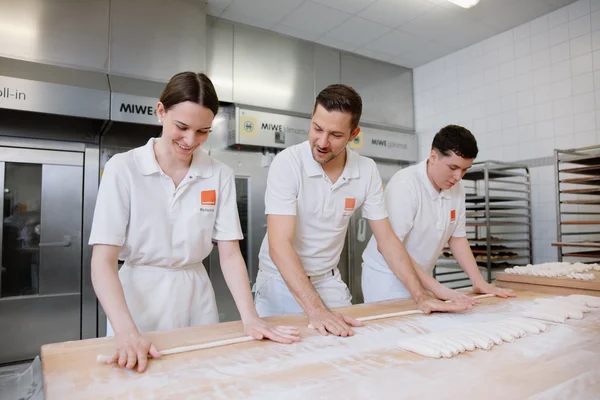
One person who knows this world like no other is Leo Jindrak. As an entrepreneur, he runs one of the country’s best-known patisseries – famous, among other things, for the Linzer Torte – whilst also championing the future of the entire food craft sector in his role as Federal Guild Master.
#schongenial: What role does the craft sector play in Austria today?
Leo Jindrak: The craft sector is of enormous importance to Austria – economically, but also socially and culturally. It is a sector deeply rooted in the regions, creating jobs, training opportunities and added value there. Many craft businesses are family-run enterprises that have been managed across generations and take responsibility for their employees and their local communities.
Furthermore, the craft sector stands for quality and reliability. At a time when so much is standardised and produced on a global scale, this represents an important counterbalance. Craftsmanship means creating something with your own hands, drawing on a high level of skill and experience. That is precisely what makes it so valuable to our society.
#schongenial: Why is it so important, particularly today, to strengthen craft trades?
Leo Jindrak: We are in a phase of change in which many traditional structures are being questioned. At the same time, however, we see that the demand for quality, regionality and individuality is on the rise again. Craft trades meet precisely these requirements. They stand for products that are not interchangeable, but have a history.
But it is also about preserving knowledge and skills. Craftsmanship is often learned and passed on over many years. If we fail to inspire young people to take it up, we lose an important part of our culture and our economic strength. That is why it is crucial to raise the profile of the craft sector and clearly highlight its opportunities.
#schongenial: You yourself run a traditional patisserie. What significance does tradition hold in your business?
Leo Jindrak: For us, tradition is the foundation of our daily work. Our patisserie has stood for the highest quality and craftsmanship for five generations now. The Linzer Torte is a very special symbol of this. It combines history, regional identity and indulgence in a unique way and is known far beyond Austria’s borders.
At the same time, tradition doesn’t mean standing still for me. We continue to develop our products, pick up on new trends and try to give classic recipes a contemporary twist. This balance between preserving and innovating is crucial for long-term success.
#schongenial: What challenges do you currently see for the craft sector?
Leo Jindrak: One of the biggest challenges is definitely the shortage of skilled workers. Many businesses are desperately looking for new recruits, yet at the same time, many young people are completely unaware of the opportunities the craft sector offers. We need more awareness-raising and greater appreciation here.
Added to this are rising costs, increasing bureaucracy and fierce competition, including from industrial suppliers. All of this makes things difficult, particularly for smaller businesses. This makes it all the more important to create framework conditions that strengthen the craft sector and enable it to play to its strengths.
#schongenial: What responsibilities do you have as Federal Guild Master for the food trade?
Leo Jindrak: In this role, I see myself as the voice of the entire food trade. It’s about representing the interests of businesses and ensuring they can operate under fair and favourable conditions. But it’s also important to me to foster dialogue within the sector and develop joint solutions.
Another key focus is securing the future – in other words, the question of how we can make the craft sector attractive to future generations. This concerns training, image, but also innovation. Because only if we continue to develop can we remain successful in the long term.
#schongenial: What makes the craft sector so special to you personally?
Leo Jindrak: For me, it’s above all the meaningfulness of the work. At the end of the day, you can see what you’ve created: a product that brings people joy and is often part of special moments. This direct feedback is something you don’t experience in many other professions.
Then there’s the variety: no two days are the same; there are always new challenges and opportunities for personal development. And last but not least, it’s the combination of tradition, creativity and quality that makes the craft so special to me.
#schongenial: Thank you very much for the interview and all the best in your work.